
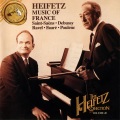
The Heifetz Collection, Volume 45 - Music of France: Saint-Saëns, Debussy, Ravel, Fauré, Poulenc
Notes by Brooks Smith It was in the early 1950s that I was offered the position of being the pianistic collaborator of the great violinist Jascha Heifetz. He had auditioned approximately 75 pianists in his search in New York City, and I was very gratified to have been chosen by him. He had told me before the audition that he was glad to find someone who had studied with Rosina and Josef Lhévinne, because he was a great admirer of Josefs playing and of the "Russian school" in general, so I felt that I had something in my favor, even if I didn't know all of the repertoire he played. When we started rehearsing I began to realize that it was going to be a difficult job—both from a personal and a musical point of view. I would appear at his home in Beverly Hills punctually after lunch every day (incidentally, if I was early I had to wait until the exact time; if I was late I caught hell from him, so I learned quickly to be right on the dot). He was critical of my playing from the very start, which I expected, but I was very surprised to learn that he was an excellent pianist himself, which was something I didn't expect. He had, of course, his own ideas about tempos, interpretation, the problems involved in first-class ensemble playing, etc., but he did say to me that if I had any suggestions about these or other details, please tell him. I tried to do this on occasion, and soon found that it would get me nowhere; after all, he was a famous virtuoso who had been in the public eye for many years and had long since decided what and how he wanted to perform. He had nine different programs he wanted to play during that first season we worked together. There were many big sonatas, even some concertos on those programs, and while I had played most of them with other violinists, there were some works brand-new to me. I had a great deal of practicing to do in learning them—and especially to perform them his way. We worked together for several months, even recording two Mozart sonatas for RCA Victor, before we ever appeared in public. I remember that the first recital we gave was in San Angelo, Texas, which seemed a good omen to me, for I am a native-born Texan, and I liked very much the idea of making my debut with the great man in my home state. Reviews were favorable, and although he prided himself on not caring a rap about what critics thought, he was pleased that I seemed to make a good impression on them. During that first year there was one evening at his home when he had invited some big musical names (Piatigorsky and Primrose among them) to join him for chamber music, and he asked me if there was anything I would particularly like to play. I had recently done the Franck Quintet in New York and Aspen, and asked if we might do that. He said, "Oh, that has quite a difficult piano part"—or words to that effect—and with that he sat down at the Steinway, without music and without warming up, and played the very difficult beginning of the Allegro, a piano solo that covers the whole keyboard and involves some virtuoso problems. My eyes were bulging and my ears ringing when he accomplished this feat, so surprised was I at the accuracy and brilliance of his playing on the piano. It proved to me that he had worked on this particular passage a great deal—and this turned out to be true of many another demanding piano part in works we played. He was critical of everything I did in the wide repertoire we performed together, even down to the fingering of some passages; but I listened to him carefully because he was so sure of what he wanted, and of course I wanted to please him and cooperate with him. During our years together we made many recordings for RCA Victor, and I still feel that of the Saint-Saëns Sonata in D Minor is about the best we ever made. Heifetz found time to make transcriptions of many works not originally written for the violin. I enjoyed particularly the five Porgy and Bess songs of Gershwin and the arrangements of works by Rachmaninoff, Mendelssohn, Schubert, Debussy, Fauré, Poulenc and others. I had known Heifetz's incomparable playing for many years before we began our collaboration, having heard all his New York recitals during my student years at Juilliard; in fact, I had even heard him during World War II, when I was a GI and he came on occasion to play for the troops. His accuracy, his intonation, his genuine excitement, his beautiful sound were all very familiar to me. After one recital we gave in Zurich, with David Oistrakh and Nathan Milstein in the audience, it was Milstein who remarked to me that one had to be a violinist to know how good Heifetz really was. This may be true, but as I worked with him during all those years, I was second to none in my admiration of him, even though performing with him was always a challenge. Los Angeles, 1993
专辑歌曲列表
-

-
-
-
-
-
-
-
-
纯音乐 大小:1.97 MB
-
-
纯音乐 大小:2.48 MB
-
-
-
纯音乐 大小:2.24 MB
-
-
-